
Blue-spotted tree monitor facts for kids
Quick facts for kids Blue-spotted tree monitor |
|
|---|---|
 |
|
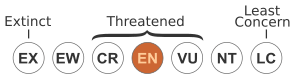
| Conservation status | |
Scientific classification  |
|
| Kingdom: | Animalia |
| Phylum: | Chordata |
| Class: | Reptilia |
| Order: | Squamata |
| Family: | Varanidae |
| Genus: | Varanus |
| Subgenus: | Hapturosaurus |
| Species: |
V. macraei
|
| Binomial name | |
| Varanus macraei Böhme & Jacobs, 2001
|
|
| Script error: The function "autoWithCaption" does not exist. | |
| Synonyms | |
|
|
Script error: No such module "Check for conflicting parameters".
The blue-spotted tree monitor (Varanus macraei) is one of the most colourful reptiles on Earth. It is also known by the common name blue tree monitor. This amazing reptile is a species of monitor lizard that belongs to the genus Varanus. It is endemic to just one small tropical island named Batanta in Indonesia. That means it lives in the wild nowhere else in the world!
Scientists place this reptile in the special subgenus (Hapturosaurus). It is named after reptile expert and herpetologist Duncan Malcolm MacRae. With its bright turquoise patterns and long grasping tail, this lizard looks almost like a tiny dragon.
Contents
Meet the Blue-Spotted Tree Monitor
Colorful Scales and Physical Features

The blue-spotted tree monitor has a jet-black body covered with bright blue spots. These spots form little eye-like rings called ocelli across its back. These rings often line up into bands. The tip of its snout is pale blue, and its lower jaw is clean white. Along its neck, you can see neat green scales arranged in a V-shaped pattern.
Between 85 and 103 rows of scales circle around the middle of its body. A sharp stripe of blue scales runs from the corner of each eye right to its ear. Its throat is pale with dark marks that form a web-like pattern.
How Big Does This Tree Lizard Grow?

Male tree monitors grow slightly bigger than females. An adult male can reach up to 1.1 metres (3.5 feet) in total length from nose to tail. Females are usually around 10 centimetres (4 inches) shorter. Even though they can grow fairly long, their bodies are slim and lightweight.
Scientists measure these lizards using snout-to-vent length, which means measuring from the nose to the cloaca opening. The tail alone is almost twice as long as the rest of the body! Because of its total length, it is the largest member of the famous prasinus group of tree-climbing lizards.
The Super-Gripping Tail
The tail of the blue-spotted monitor works like an extra hand. It is completely prehensile, which means it can curl tightly around tree branches. The tail is decorated with 22 to 23 neat blue rings. When climbing through the high canopy, the lizard wraps its tail around twigs so it never falls down.
Where Does the Blue Tree Monitor Live?
An Island Home in Indonesia
This rare lizard lives exclusively on the island of Batanta. This island sits near the Vogelkop peninsula in the Indonesian region of West Papua. The entire island has an area of only 450 square kilometres. That is roughly the exact same size as Lake Constance in Central Europe!
Because the island is so tiny, this species has one of the smallest geographic homes of any monitor lizard. If its forest home is harmed, the lizard has nowhere else to go.
Life in the Tropical Rainforest
The island of Batanta has a very warm and steamy climate. Blue-spotted monitors live high in the tropical canopy where temperatures stay between 28 and 38 degrees Celsius (83 to 100 degrees Fahrenheit).
The air on the island is always full of moisture. During the dry season, the humidity is around 65 percent. In the rainy season, the humidity rises all the way up to 100 percent. The lizards love this warm, damp air because it keeps their skin healthy when shedding.
How Was the Blue Tree Monitor Discovered?
Duncan MacRae's Journey
For a very long time, modern scientists did not know this blue lizard existed. In the year 2000, stories about an unusual blue tree climber reached Duncan MacRae on the island of Bali. He travelled across Indonesia by boat to visit the remote island of Batanta.
Local people who lived on the island knew the animal well. They guided MacRae deep into the thick forest where they had spotted the lizards running along high branches. MacRae noticed that while it moved like a green tree monitor, its bright blue colour was completely unique.
Officially Named by Science
MacRae took clear photographs of the lizards and sent details to German reptile scientist Wolfgang Böhme. Dr. Böhme and his partner Hans J. Jacobs examined the animals carefully. They proved that it was not just an odd colour shade, but an entirely new species.
They officially named the lizard Varanus macraei in 2001 in honor of Duncan MacRae. Later, researchers like Thomas Ziegler and Fabrizio LiVigni studied how the lizard fits among other monitor species.
Daily Life and Behavior in the Wild
Tree Climbers of the Canopy

The blue-spotted monitor is fully arboreal, meaning it spends nearly its whole life in trees. It is also diurnal, which means it is awake and active during the day and sleeps at night.
When a predator like a hawk or snake comes near, the monitor uses a smart trick. It quickly scrambles to the other side of a tree trunk. By keeping the thick wood between itself and the intruder, it stays completely hidden from sight.
What Do They Eat?
These fast lizards are skilled hunters. They use their sharp eyesight and long claws to catch food in tree branches. While nobody has done a full wild diet survey yet, their meals look very much like those of other tree monitors.
Their favourite foods include:
- Stick insects that blend into twigs
- Crickets, katydids, and orthopterans (grasshoppers)
- Tree moths and hard-shelled beetles
- Small tree lizards and tiny bird eggs
- An occasional bite of soft forest fruit or berries
Reproduction and Life Cycle
Like many other reptiles, the blue-spotted tree monitor relies on oviparous reproduction, which means the mother lays eggs.
Female lizards carefully hide their soft-shelled eggs in warm, damp spots high in trees or inside tree hollows. The warm tropical climate naturally incubates the eggs. When the baby lizards hatch, they are already independent and equipped with sharp claws. They immediately start climbing higher to avoid predators on the forest floor.
Caring for the Future of Blue Tree Monitors
Hidden Relatives in the Wild
Years ago, scientists only recognized five species in the tree monitor group. These included the green tree monitor (Varanus prasinus) and the black tree monitor (Varanus beccarii). Soon, other species like Varanus boehmei and Varanus reisingeri were identified. Many of these species look alike, but their skin patterns and scale counts help scientists tell them apart.
Protecting a Rare Island Treasure
Because the blue-spotted tree monitor has dazzling colours, people around the world want to see it. Sadly, taking these lizards from the wild harms their wild population. Indonesian law strictly protects the species, making wild capture illegal.
Dedicated zoos and reptile caretakers have built successful breeding programmes to protect them. Zoos like the Cincinnati Zoo and the Virginia Zoo have hatched healthy young monitors. By studying these captive lizards, scientists learn how to protect the wild forests of Batanta so these turquoise dragons can thrive forever.
